
For months, President Trump has been calling for an end to the Senate filibuster -- the rule which requires 60 votes to "end debate" and move a bill to final vote on the Senate floor.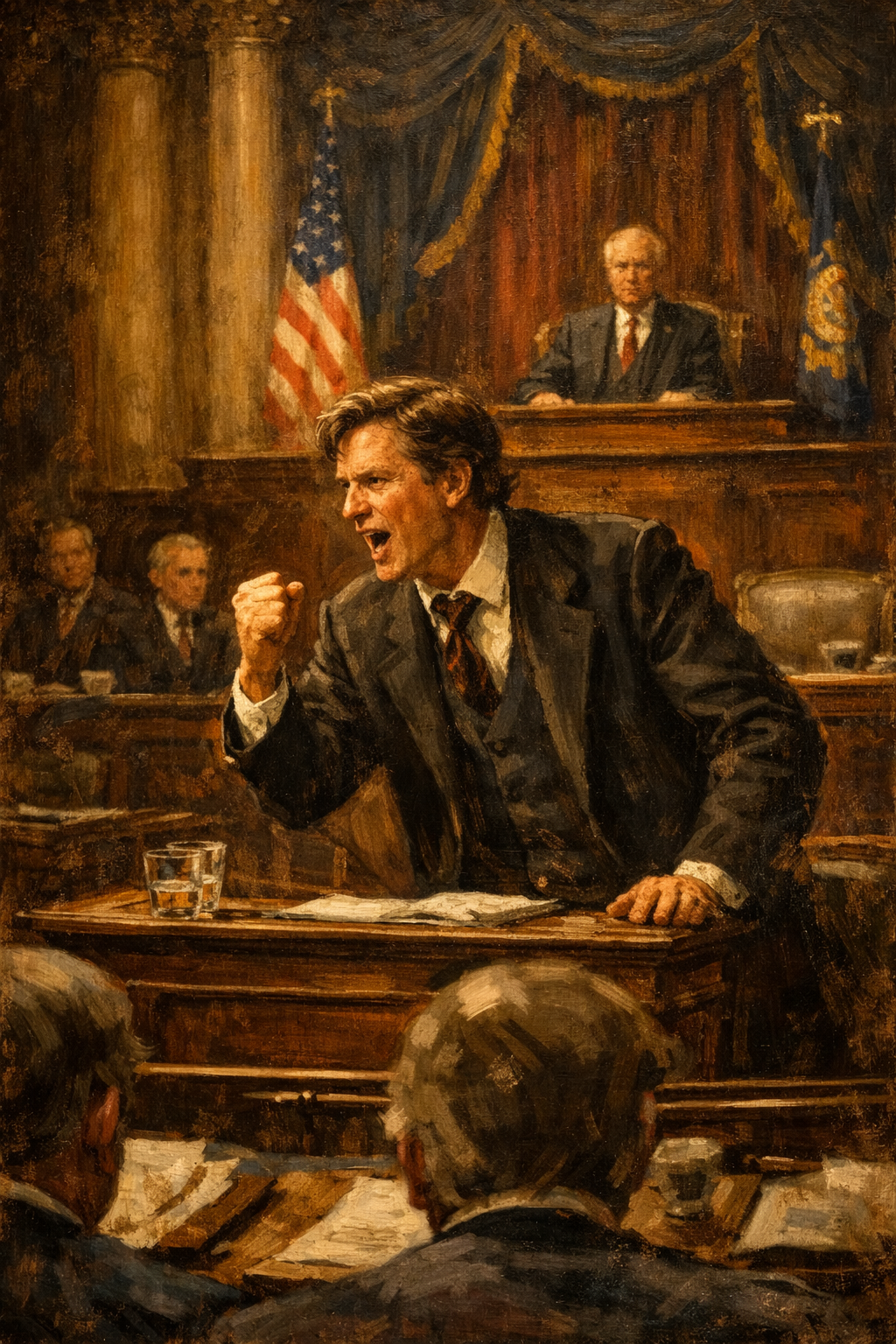 This has been positioned as a "radical" view, even by those in leadership in the Senate. The 60-vote threshold has been put forth as a sacred standard.
But the current structure of the filibuster is a relataively modern invention. The current filibuster (we're calling it the "zombie" filibuster) is actually a far cry from the original design of the filibuster (what is now called the "standing" filibuster).
President Trump may have been better served by proposing the Senate return to its historic roots and re-establish the Standing Filibuster instead of "eliminating" the filibuster.
Two filibusters...
A standing filibuster is the original, old-school version of a filibuster in the United States Senate. Under that model:
- The minority must physically hold the floor
- Senators must keep speaking continuously
- They must remain present, upright, and debating
- If they stop talking, sit down, or yield the floor, the filibuster collapses
- The majority can then proceed to a vote with a simple majority
So if the minority wants to block a bill, they would have to:
- Put senators on rotating shifts
- Speak for hours or days
- Endure political, physical, and media pressure
- Own the obstruction in public view
This is very different from today’s system. Today, the "zombie" filibuster is mostly silent.
- A senator merely signals intent to filibuster
- Debate does not need to continue
- No one has to speak (thus, "zombie" filibuster)
- The bill is automatically stalled
- The burden shifts to the majority to find 60 votes for cloture
In practice:
One email or phone call can halt legislation supported by 59 senators. That’s why people say the modern filibuster is less a debate tool and more a super-majority requirement by default.
Why the original filibuster existed
The filibuster wasn’t created intentionally—it emerged accidentally from Senate rules in the early 1800s—but it rested on a clear theory: the Senate should protect intense minority conviction, but obstruction should be costly. Blocking action requires speaking and suffering some political risk. You could slow the body—but only by effort, not by inertia.
The standing filibuster wasn’t abolished outright. It was abandoned due to the Senate’s expanding workload and the leadership’s desire to control the floor. Reformers wanted to reduce the power of obstructionists—so they changed procedure instead of confronting the filibuster directly.
Ironically, the fix made obstruction easier, not harder. But now, some are wanting to revive the standing filibuster to:
- Restore visibility
- Force argument instead of veto
- Make obstruction politically expensive
- Shift burden back to the minority
- Preserve minority rights without granting minority control
That’s why some say: “If you believe strongly enough to stop a bill, prove it—on your feet.”
Standing Filibusters are difficult. In the United States Senate:
- Any senator who has the floor may speak
- A senator may yield the floor to another senator
- That new senator may speak as long as they maintain continuous debate
Coordination must be flawless. One mistake ends the filibuster. The challenge for the majority is, they must maintain enough Senators on or near the Senate chamber to maintain a quorum.
No Rule Change Needed
Interestingly, no rule change is needed. That’s because a Senate majority can reinterpret its rules at any time by establishing a new precedent with 51 votes. In the case of a Standing Filibuster:
- A senator raises a point of order, e.g. “Debate may continue only if senators are continuously speaking.”
- The presiding officer rules on that point of order
- The minority appeals the ruling
- The full Senate votes on whether to uphold the ruling
- 51 votes uphold it and a new precedent established
This is not theoretical. It’s been done repeatedly. No constitutional amendment. No 60 votes. No rule rewrite on paper. This is exactly how:
- the judicial filibuster was ended (2013)
- Supreme Court filibusters were ended (2017)
This maneuver is commonly (and loosely) called the “nuclear option.” Clearly, the Senators call it a “nuclear” option because THEY don’t want to do it!
How the "zombie" filibuster is destroying the Senate
The current “zombie” filibuster:
- Empowers the minority
- Provides political cover for all Senators since 60 votes are needed for most actions
- Allows Senators to oppose a bill without ever having to say a word
- Gives Senate leaders more control over the Senate floor
But the current Zombie filibuster also actually crushes real debate, and that’s the irony. The standing filibuster is actually more deliberative, restores public debate and removes the silent veto. But it is labeled “radical” by those who hold power.
As a result, backroom “whip” counts replace public debate and “cloture” votes only happen when the majority knows it has 60 votes or wants to make a statement as to why it can’t get something done. And everyone leaves for home on Thursday afternoon happy.
For decades, Senators have upheld the “zombie” filibuster as if it were etched in the Constitution. Far from it. Per the Constitution, each Senate is sovereign over its own rules. Thus, this current Senate cannot write a rule that is binding on the next Senate. A new precedent can always be set with 51 votes.
Restoring the original Standing Filibuster could actually save the filibuster, which many expect this or the next Senate will abolish altogether. That’s because the Standing Filibuster would:
- Reduce how often it’s used
- Restore deliberation
- Preserve minority leverage without minority control
- Reduce pressure for full abolition
Today, the zombie filibuster is dying because it:
- blocks everything
- is costless to use
- feels illegitimate to the majority
- incentivizes rule-breaking as the only escape
Yes, the Standing Filibuster may slooooooow down the Senate. But that’s not a bug. Historically, it’s a fix. The Senate is designed to be the slower, more deliberative body. Restoring the standing filibuster to the the Senate would:
- Filter out symbolic legislation
- Reward coalition-building
- Favor durable laws over partisan ones
- Re-anchor the Senate as an institution of restraint
With the zombie filibuster, the Senate behaves as if it has a 60-vote requirement for everything. It makes Senators’ lives actually easier. But the zombie filibuster is actively breaking real governance and is contributing to the dysfunction of Congress because it:
- Destroys incentives to actually legislate. Everything shifts to messaging votes. Real governing moves to executive action and the courts. Senators get a free pass and can say “we tried.”
- Centralizes power in leadership. Leaders control the floor and debate is limited. Committees mean less. Open debate is perceived as dangerous and disruptive (again, they have to leave on Thursday).
- Actually radicalizes outcomes. When normal legislation becomes impossible, the majority reaches for “nuclear” options, carve-outs, exceptions, and massive, omnibus bills that are full of enough pork to make everyone at least a little bit happy.
To summarize:
The filibuster was meant to slow the Senate by forcing speech.
It now slows the Senate by preventing speech.
Restoring the standing filibuster, and the Senate
Originally, the destructive consequences of the zombie filibuster may have been unintended. But when Senators realized it gave them more control and a huge shield of political cover (and long weekends), the consequence became intended. And now the Senate is a shell of the institution it once was.
The Senate claims to be the “world’s greatest deliberative body.” But its dominant practice discourages deliberation. Speech is treated as a risk, not a virtue. Debate becomes symbolic, not operative. That has led to: less debate, more messaging votes, more governing by executive action and more “legislating,” by default, “delegated” to the courts. And everyone is angry.
Institutions often collapse not because they abandon their principles, but because they preserve them in form while hollowing them out in practice. This is precisely what has happened. The filibuster still exists on paper. Debate exists in theory. But debate is now optional. And everyone has a finger of blame they can point at somebody across the aisle.
It’s time to restore the historic, Standing Filibuster, and do it for a historic debate and vote on the SAVE America Act.

Do you like this page?